AI sound generator guide: How to create sound effects with AI
Discover how Envato's AI sound generator creates custom sound effects from text prompts so creators can skip library searches and edit faster.
Envato: Get every type of asset for any type of project, and access to AI tools. Start now
"A single creative can realistically replace an entire agency."
Our first AI in creativity report landed with a statistic that made people uncomfortable: 58% of creative professionals have used AI in client work without disclosing it. Some didn’t see the need to mention every tool in their kit. Others felt genuinely guilty about keeping it quiet.
The data revealed something deeper than a simple ethics debate about AI in creative work. While nearly half of all creatives now use AI daily, 69% don’t feel prepared for an AI-driven industry. Younger professionals adopt it fastest but struggle with mastery. Older creatives feel mounting pressure as clients assume AI makes everything instant and cheap. And across every discipline, there’s a persistent question that nobody has definitively answered: when do you tell clients you’re using it?
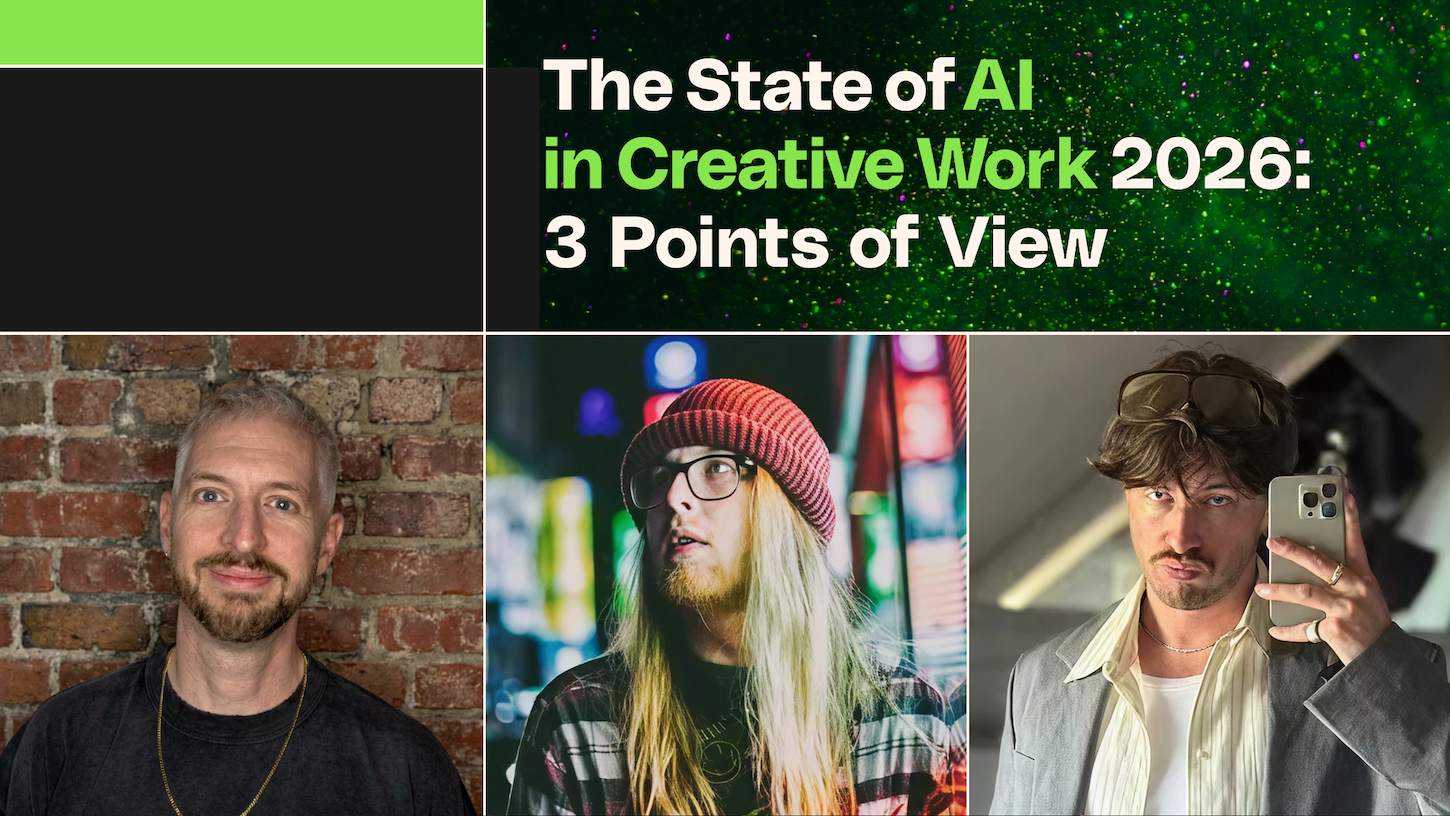
We wanted to understand the gap between what the numbers show and what it actually feels like to build a creative practice around AI right now. So, we spoke to three people who were doing exactly that. Not consultants or researchers, but working creatives who’ve structured their entire businesses around these tools and are navigating the same tensions everyone else is trying to figure out.
Ohneis has built a following teaching AI design on Instagram while creating hyperrealistic product campaigns for major global banks and tech companies. Based in Europe, he runs workshops for teams integrating AI strategically, condensing what typically takes six months of trial and error into structured, actionable training. His perspective on disclosure gets at something the survey data hinted at but couldn’t fully explain.
“When it comes to disclosing AI use, I think it’s a bit like photography used to be,” he told us. “Photographers didn’t explain what tools they used, whether Lightroom, Photoshop, or something else. Clients never knew exactly what went into the final image. You could say AI works the same way, but I’d still be more cautious. Especially for large companies, IP rights and legal frameworks are a big deal, and a lot of the laws around AI are still unclear. So personally, I’d always disclose it.”
That caution comes from experience. When you’re operating as a solo creative competing against agencies, transparency becomes a strategic, not just an ethical, necessity. And the economics have fundamentally shifted.
“For solo creatives, AI becomes especially powerful when you already have a range of skills,” Ohneis explained. “As a generalist, you can basically multiply your own abilities. A single creative can realistically replace an entire agency. I’ve seen it myself. The output can be just as good, if not better, simply because there are no long approval chains. You make decisions yourself, test ideas instantly with AI, and even get critical feedback from it in real time.”
Freelancers dominate the visibility around AI adoption, but the actual usage data reveals something different: agency owners use it daily at a rate of 58%, compared to 48% of freelancers. They just talk about it less. Ohneis represents why freelancers often get the perception of being leaders. He posts his AI work publicly, teaches his process, and builds his brand around being an early adopter. For him, that visibility is the marketing strategy.
But he’s also clear about what separates people who successfully integrate AI from those who don’t. “What sets apart the people who’ve actually succeeded? They got a real sense of what’s possible and learned how to use the best tools available right now, along with how to communicate with them effectively. None of it is secret knowledge. You could find it all online. The difference is that this condenses what would normally take six months of trial and error into something structured and immediately actionable.”
Our survey revealed that while 49% of creatives utilize AI daily, only 31% feel very well-prepared. Ohneis pinpointed why. “If there’s one AI skill everyone should learn, it’s this: breaking problems down. When you overload a model with too much information, the output usually gets worse. Therefore, you must break down the problem into distinct, logical components and describe each part in a manner that the AI can comprehend. Right now, learning how to communicate with AI, how to speak its language, is one of the most valuable skills you can have.”
On the business side, the math has undergone a complete transformation. “What would normally take an agency months can now be done in a few weeks by one person. Clients are still willing to pay strong rates, maybe not exactly what they’d pay a full agency, but still strong numbers. The difference is that as a solo creative, you need far less time and overhead to deliver, which means your margins are significantly higher.”
The report found that 60% of creatives cite clients assuming AI makes everything faster and cheaper as their top challenge. Ohneis lives in that tension every day. His take on the creative impact cuts through the doom-and-gloom rhetoric that has dominated the conversation.
“I don’t believe creativity or craftsmanship is dying. What’s happening is that a new form of creativity is emerging. Creativity isn’t about how skilled you are with your hands. A painter isn’t creative just because they paint well, but because they have a vision. Some people have great ideas but never learned how to express them physically or technically. AI gives them that outlet.”
He continued: “And that’s the real shift: the speed of creation. You can have an idea in the morning and visualize it within minutes. Before, you had to find a location, book a model, do the shoot, and hope it turned out how you imagined. Now, you can test and refine concepts instantly. That changes what creativity means.”
Rupert Cresswell runs Elevado, a hybrid live-action and AI production studio in Los Angeles. Working under his creative alias Prospex Park, his AI artwork went viral in 2020-2021, earning features in The New York Times and leading to gallery shows and brand partnerships that eventually led him to launch his company. Today, Elevado works with major global brands, navigating complex legal compliance while pushing creative boundaries. His perspective on disclosure is shaped by very different pressures than those faced by solo creatives.
“We’ve never not disclosed,” Cresswell said. “The amount of hoops we have to jump through to be compliant with our brands’ legal teams is huge. We’ve had to become experts on the various terms of service for all these AI tools, as well as what we can and can’t do. We have strong policies about ethical prompting, what we do with people’s IP, and our clients’ IP. We’re not only upfront about using AI, but before we start the project, we review the entire list of workflows we’re going to undertake and ensure they are compliant. Everyone has their own rules about which tools they can and can’t use.”
The survey finding that 58% have used AI without telling clients struck him as revealing something deeper. “Either lying or feeling guilty, both of those are weird situations to be in. Perhaps it reveals a pressure surrounding AI, indicating a genuine desire and need for artists to use these tools, as they are truly beneficial to them, and they’re having to pretend otherwise. There should be more transparency around what artists, designers, whatever want and need to use as tools.”
Cresswell’s approach to client conversations centers on reframing what AI makes possible, rather than just making it faster. “We always take the approach that faster and cheaper is not a good place to start. We’re more interested in: what other things can AI do that other processes can’t? What new door did you just open up creatively?”
The report found that 43% of creatives struggle to stand out in a sea of AI-generated content that appears similar. Cresswell sees this as the defining challenge. “The more AI means more content created, the more the middle ground gets flooded with similar stuff. The differentiator is the creative and the creative idea. If you come at things from a slightly esoteric angle that makes no sense for an algorithm to mine, you’re going to make something more unique.”
He continued: “To us, the creative is the differentiator in a world of AI-produced content. Having those ideas, coming up with good creative ideas, and executing them well, having good taste, and looking for things that are slightly different. It’s the same thing that artists, creative directors, filmmakers, and fashion designers have always used to stand out. It matters more with AI because you’re trying to step out of this massive tidal wave of sameness.”
When we asked about the public’s reception of AI work, his answer addressed why transparency without creative intent still fails. “It’s amazing when you put something out with a cool idea done in an interesting new way, how much more receptive the public is. It’s when AI is being used to replace something else or mislead people that concerns arise. Or if it’s badly made. People have low tolerance for that. So, if you have a good idea and it’s well-crafted, you’ll be surprised by the reaction. It doesn’t really matter how you made it.”
The generational data in the report showed that Gen Z used AI the most, but Gen X felt the business pressure the hardest. Cresswell’s take: “If you’ve been working in something for 20 years, it’s hard to break out of it. But I think a lot of it is mindset. You just have to, regardless of your age, remain curious and try new things. It’s a tough industry to be in, and you always have to relearn and adapt all the time.”
His advice for navigating the overwhelming scale of AI discourse felt particularly grounded. “If you start thinking about AI in terms of its huge implications for the world, it becomes almost impossible to comprehend or get involved with in any useful way. I try to keep it small: how does this one tool help me with this one project? I’m not a futurologist. I can’t predict what will happen even six months from now. But if there’s one piece of advice I can pass on: think small. Consider yourself and what you need to do. What’s the idea? What’s the project? Can AI help you achieve that? If you keep things small, you’re much more likely to keep your eye on the prize.”
And then the closing point that cuts through all the anxiety: “What concerns me is if artists and creators just shut the door on this. You’re leaving it to people who don’t have artists’ and creators’ interests at heart. Be part of the conversation. Be part of making these tools work for you.”
James Gerde founded Gerde Got It, a Seattle-based company at the forefront of AI-powered video transformation and video-to-video style transfer technology. With a background as a filmmaker, director, and composer in Seattle’s creative scene, he launched his AI-focused production company in 2023, following years of freelance filmmaking. His work spans music videos, commercial films, and artistic projects that explore how AI can enhance rather than replace creative vision. His perspective bridges traditional production and AI-native workflows.
“It happened the moment I realized I could create full, cinematic pieces entirely within my own ecosystem,” Gerde told us about when AI shifted from experiment to business foundation. “Once I didn’t have to rely on traditional crews or expensive equipment to bring an idea to life, I knew this wasn’t just a tool. It was the foundation of a whole new creative business model.”
The report found that AI adoption varies dramatically by discipline. Web developers lead at 65% daily use, followed by marketers at 60% and content creators at 58%. Meanwhile, graphic designers and motion graphics artists both sit at 40%. Gerde sees this split as structural, not generational. “Content creators are used to constant evolution. They adapt fast because their platforms move fast. Traditional designers often come from more structured environments, where craft is tied to long-established processes. AI disrupts that stability, so it’s natural that creators who thrive in chaos are the first to jump in.”
On the competitive dynamics between solo creatives and agencies, Gerde emphasized the importance of agility. “Small teams can move fast. They don’t need approval from ten people before trying a new workflow. That freedom to experiment is a huge advantage right now. The ability to pivot and explore without bureaucracy means they can ride the wave of innovation in real time.”
But he’s careful about how speed gets framed in client conversations. The survey revealed that 60% of creatives face pressure from clients who expect faster and cheaper work. “Speed doesn’t mean simplicity,” Gerde said. “Just because AI can accelerate certain parts of production doesn’t mean the creative thinking, taste, or execution are any less valuable. I think creatives need to reframe AI as a premium service. What clients are paying for is precision and vision, not just speed.”
When asked about disclosure, his view is pragmatic and evolving. “Right now, transparency is important. Clients deserve to know how the work is made, especially since AI is still new and misunderstood. But over time, I think it’ll become like Photoshop. No one feels the need to disclose every adjustment they make. Once it becomes an industry norm, disclosure won’t carry the same weight.”
The report highlighted emerging roles, such as AI Creative Directors and Prompt Engineers. Gerde sees the job market shifting toward hybrid specialization. “We’ll see fewer prompt engineers and more hybrid creative roles, like AI directors, model stylists, and synthetic environment designers. People who can combine aesthetic judgment with technical knowledge are going to be in high demand.”
His take on what AI literacy actually means goes beyond prompt writing. “AI literacy. Not just prompts, but understanding how to use AI to think differently. Whether that’s in image generation, video, or writing, being able to guide a model with creative intention is the real skill, not memorizing syntax.”
On video specifically, he sees fundamental infrastructure shifts happening now. “We’re already seeing major shifts in how people approach animation, live-action editing, and compositing. AI video tools are finally reaching a level where motion, lighting, and storytelling can all be integrated into a single pipeline. That’s going to change everything.”
The survey found that only 31% of creatives feel very prepared despite high usage rates. Gerde’s prediction challenges the narrative that AI flattens creativity. “A lot of creatives assume that AI takes creativity away or makes the work less personal. But in reality, it’s the opposite. The artists who lean into AI the right way are often the ones who can express themselves more fully, not less. It’s not about replacing ideas. It’s about speeding up the translation of what’s in your head into something you can actually see and build on.”
He continued: “AI won’t make creativity less human. It’ll make it more human. It’s giving people who never thought they could create a voice, a vision, and a medium. The surprise will be that creativity expands, not contracts.”
His final insight reframes our understanding of AI’s role. “We’re entering a time where creative work will feel less like production and more like performance, where the artist’s choices in real time matter as much as the outcome. The future isn’t about automation. It’s about amplification.”
The gap between usage and preparedness in AI in creative work isn’t closing on its own. These three creatives have found their footing by treating AI as infrastructure rather than a novelty, building transparency frameworks that align with their business models, and focusing on creative differentiation rather than competing solely on speed.
The disclosure question remains unresolved because the industry has not yet settled on shared standards. Some clients explicitly want human-only work. Others request AI for efficiency. Many don’t ask because they assume you’re already using it. The 58% who’ve stayed quiet aren’t necessarily hiding something unethical. They’re navigating a period where expectations are misaligned and consequences unclear.
What’s consistent across all three perspectives: this isn’t about whether to adopt AI; it’s about how to do so effectively. That decision has been made by market forces. The question is how to integrate it with intention, price it appropriately, and maintain the creative judgment that separates good enough from actually good.
Download the full report to see where your discipline, generation, and geography fit in the broader shifts reshaping AI in creative work. The data covers six major themes, includes practical 30-60-90 day playbooks for different business models, and maps emerging roles already taking shape in an AI-native industry.
Not yet. Our Beyond Adoption report found that 58% of creative professionals have used AI in client work without disclosing it, though attitudes toward transparency are shifting as AI becomes standard practice.
Very common. Nearly half (49%) of all creatives surveyed use AI daily for client work, with web developers (65%), marketers (60%), and content creators (58%) leading adoption rates.
That’s a common client assumption, and 60% of creatives cite it as their top challenge. Professionals who thrive reframe AI as a premium capability — one that expands what’s creatively possible, not just what’s affordable.
Start small. Focus on one tool and one project rather than trying to comprehend AI’s entire impact. Break problems into distinct components, learn how to communicate with models effectively, and build from there.
It depends on context. Solo freelancers may treat AI like any other tool in their kit, but agency-level work with major brands often requires full legal compliance and upfront disclosure of AI workflows before a project begins.
There’s a gap between adoption and mastery. While usage is high, 69% of creatives don’t feel fully prepared for an AI-driven creative industry — largely because tools evolve rapidly and structured training hasn’t caught up.
The professionals we spoke to say no — but it is reshaping them. Expect more hybrid roles like AI Creative Directors and synthetic environment designers, where aesthetic judgment and technical fluency combine.
Discover how Envato's AI sound generator creates custom sound effects from text prompts so creators can skip library searches and edit faster.

We tested 9 AI image generators on identical artistic prompts (same style-transfer task, same day) to see which one actually paints like an artist.
AI isn't making full movies yet; it's reshaping VFX, editing, and dubbing. Here's where it helps filmmakers today, and where it doesn't.

A practical, step-by-step guide to making a short AI film — from script and shot lists to character consistency, voice, sound, editing, cost, and legal rules.