How to edit with AI using Envato stock photos
Learn how to edit with AI on Envato stock photos, customizing images instantly by removing objects, changing backgrounds, and creating polished visuals without leaving the platform.
Envato: Get every type of asset for any type of project, and access to AI tools. Start now
A peer-reviewed study of 800 people found AI made them more creative, not less. The findings challenge how the industry talks about AI tools.
There’s a persistent assumption about AI and creativity that goes something like this: AI does the work, humans step back, and the result is faster but shallower. It’s a tidy narrative — and according to a major new study, it’s wrong.
Researchers at Swansea University (UK) recently published one of the largest studies to date on AI and human creativity. More than 800 participants were given an AI-supported system to design virtual cars. The goal wasn’t to test whether AI could do the designing — it was to understand what happens to human creativity when AI is part of the process.
The results challenge the automation anxiety that still dominates the conversation around AI in creative fields.
The assumption that AI speeds things up and sends people on their way didn’t hold. Participants who worked with AI-generated design galleries actually spent more time on the task, not less. They explored more options, engaged more deeply with the process, and produced stronger results than those working without AI support.
This isn’t a story about efficiency. It’s a story about engagement.
Dr. Sean Walton, the study’s lead author and a Turing Fellow at Swansea, put it plainly: “People often think of AI as something that speeds up tasks or improves efficiency, but our findings suggest something far more interesting. When people were shown AI-generated design suggestions, they spent more time on the task, produced better designs and felt more involved. It was not just about efficiency. It was about creativity and collaboration.”
The experiment used a tool called The Genetic Car Designer, where participants designed simple two-dimensional cars. While they worked, an AI system generated visual galleries of design concepts alongside them — not one optimized suggestion, but a whole spread.
The system used an algorithm called MAP-Elites, which produces structured variety rather than converging on a single best answer. So the galleries included strong-performing designs alongside unconventional ones, unusual aesthetic directions alongside intentionally imperfect options.
Participants could browse these galleries at any point. Nobody was forced to use a suggestion or copy a result — the AI output was there as a reference to react to, borrow from, or ignore entirely. Compared against a control group, participants exposed to the diverse MAP-Elites galleries showed significantly higher creative engagement and produced stronger final designs.
Here’s where it gets really interesting for anyone working with generative AI. The study found that the diversity of AI output mattered — a lot. Participants responded most positively to galleries that included a wide range of ideas: strong concepts, unusual directions, and even some intentionally flawed designs.
Why? Because that variety broke people out of their initial assumptions. Instead of fixating early on a “safe” direction, they explored more of the creative space available to them. The researchers describe this as preventing “early fixation” — a well-known creativity killer where you lock onto your first decent idea and stop looking.
Bad ideas, it turns out, are part of what makes the good ones possible.
If you’ve ever scrolled through a set of AI-generated images and found that the weird one sparked a direction you’d never have considered on your own, you’ve felt this firsthand.
This research lands at a moment when AI tools are woven into creative work more deeply than ever. From image generation and video production to music composition and motion design, creatives aren’t just experimenting with AI anymore — they’re building it into their daily process.
At Envato, this is something we see reflected in how creative pros use Envato’s image generator, AI video generator, and the rest of our gen AI creative suite. Our State of AI in Creative Work 2026 report, which surveyed 1,780 creative professionals, found that 45% say AI boosts speed and experimentation — but the Swansea study suggests the benefit runs deeper than even that. The most effective workflows aren’t the ones where someone types a prompt and ships the first result. They’re the ones where AI generates a range of possibilities — different styles, different compositions, different moods — and the creative uses that range as a springboard for their own vision.
It’s less “AI did it for me” and more “AI showed me something I wouldn’t have seen on my own.”
The Swansea study also raises an important point about how we evaluate AI tools in creative contexts. Standard metrics tend to focus on surface-level behavior — how often someone clicks on a suggestion, or how quickly they complete a task. The researchers argue that these measures miss the deeper picture: how AI influences thinking, emotional engagement, and willingness to take creative risks.
This resonates with a shift we’ve been tracking across the creative industry in 2026 — one we explored in depth in our Creative Trends 2026 series. The conversation is moving beyond “can AI make this?” toward “how does AI change the way I think about making this?” It’s a more nuanced question, and it’s the one that actually matters for the future of creative work.
If there’s a practical takeaway from this research, it’s this: let AI show you things you wouldn’t choose yourself. Don’t just generate the thing you already had in mind. Use AI tools to surface variety — unexpected styles, unfamiliar compositions, options that feel slightly wrong. That’s where the creative friction lives, and according to this study, that friction is exactly what makes the collaboration valuable.
As AI becomes more embedded in creative fields, the question worth asking isn’t just what the tools can produce — it’s how they change the way you think about what you’re making. Based on 800 participants and a peer-reviewed journal, the answer is clear: they make you braver and more creative.
Your next brilliant idea is probably hiding in a direction you haven’t explored yet. Envato’s AI tools can help you find it.
According to a new study, yes! A Swansea University study found AI-generated suggestions made participants more engaged, more exploratory, and better at producing quality creative work.
A wide range of AI-generated options — including unexpected ones — prevents “early fixation,” pushing you to explore further before committing to a direction.
No. The study found AI’s value came from how it influenced human decision-making. The person in the loop — bringing taste, judgment, and expertise — is what made the difference.
Over 800 participants shown diverse AI-generated design galleries spent more time on the task, took more creative risks, and produced stronger final designs.
Generate a wide range of options before narrowing down. Using AI to explore different directions, then applying your own judgment to refine, leads to stronger outcomes than chasing a single perfect result.
An algorithm that generates a diverse range of solutions rather than converging on a single best one. In the Swansea study, it produced varied visual galleries that encouraged broader creative exploration.
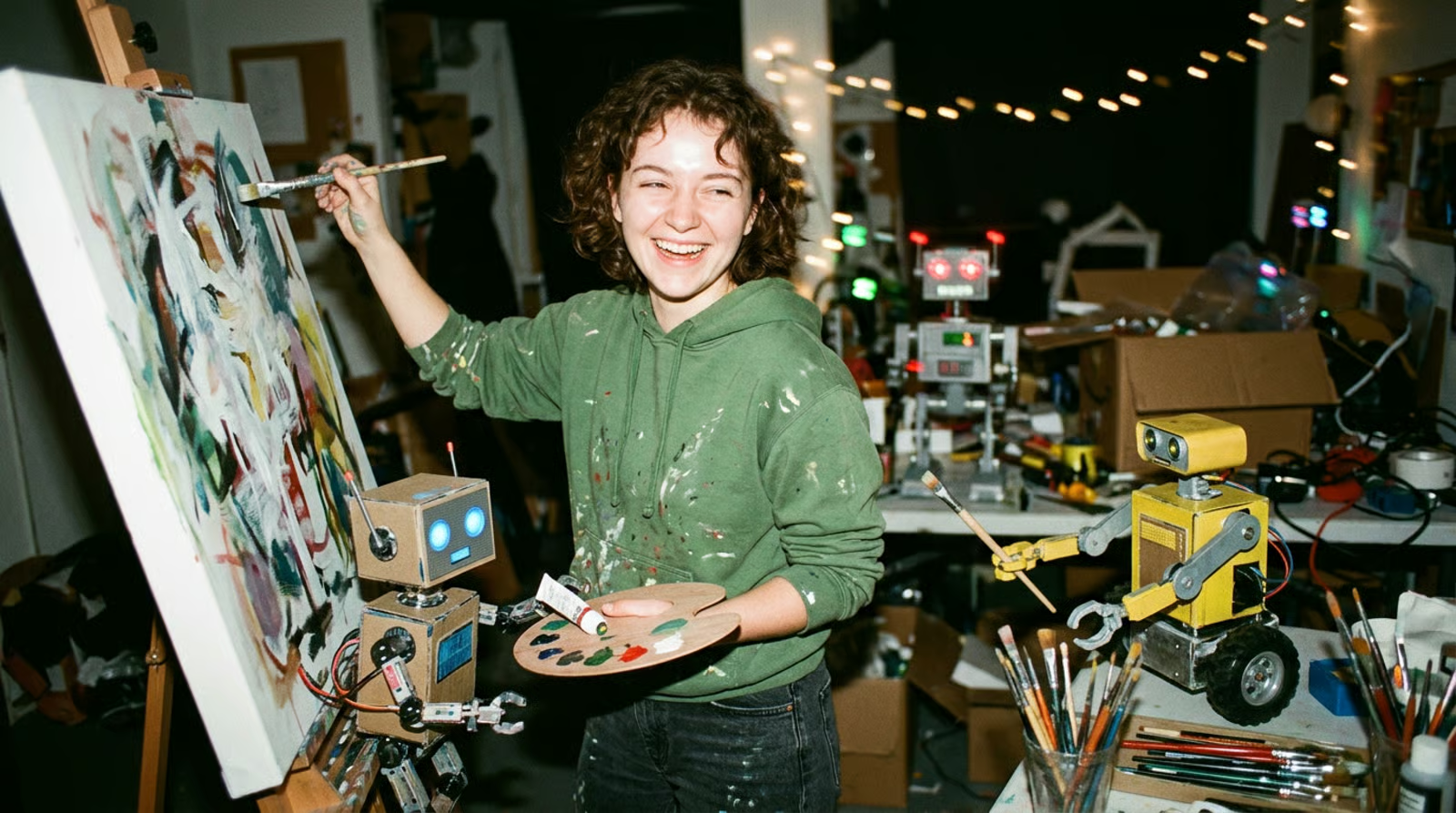
Header image created with Envato’s AI image generator.
Learn how to edit with AI on Envato stock photos, customizing images instantly by removing objects, changing backgrounds, and creating polished visuals without leaving the platform.

Discover how Envato's AI sound generator creates custom sound effects from text prompts so creators can skip library searches and edit faster.
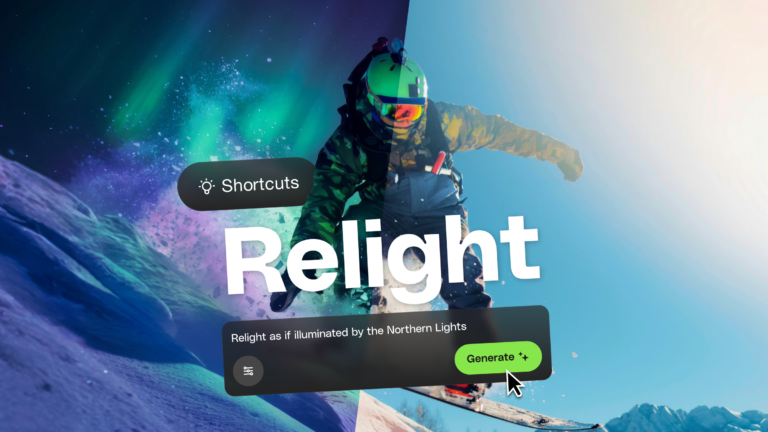
Learn how AI photo relighting works in Envato Shortcuts. Change lighting, mood, and shadows in seconds with guided AI workflows.

Discover how sonic branding AI tools help you create unique brand sounds, from audio logos to UI effects, and build a consistent, memorable sonic identity across platforms.