AI sound generator guide: How to create sound effects with AI
Discover how Envato's AI sound generator creates custom sound effects from text prompts so creators can skip library searches and edit faster.
Envato: Get every type of asset for any type of project, and access to AI tools. Start now
Two real workflows, two disciplines, one toolkit — what a creative workflow with AI actually looks like.
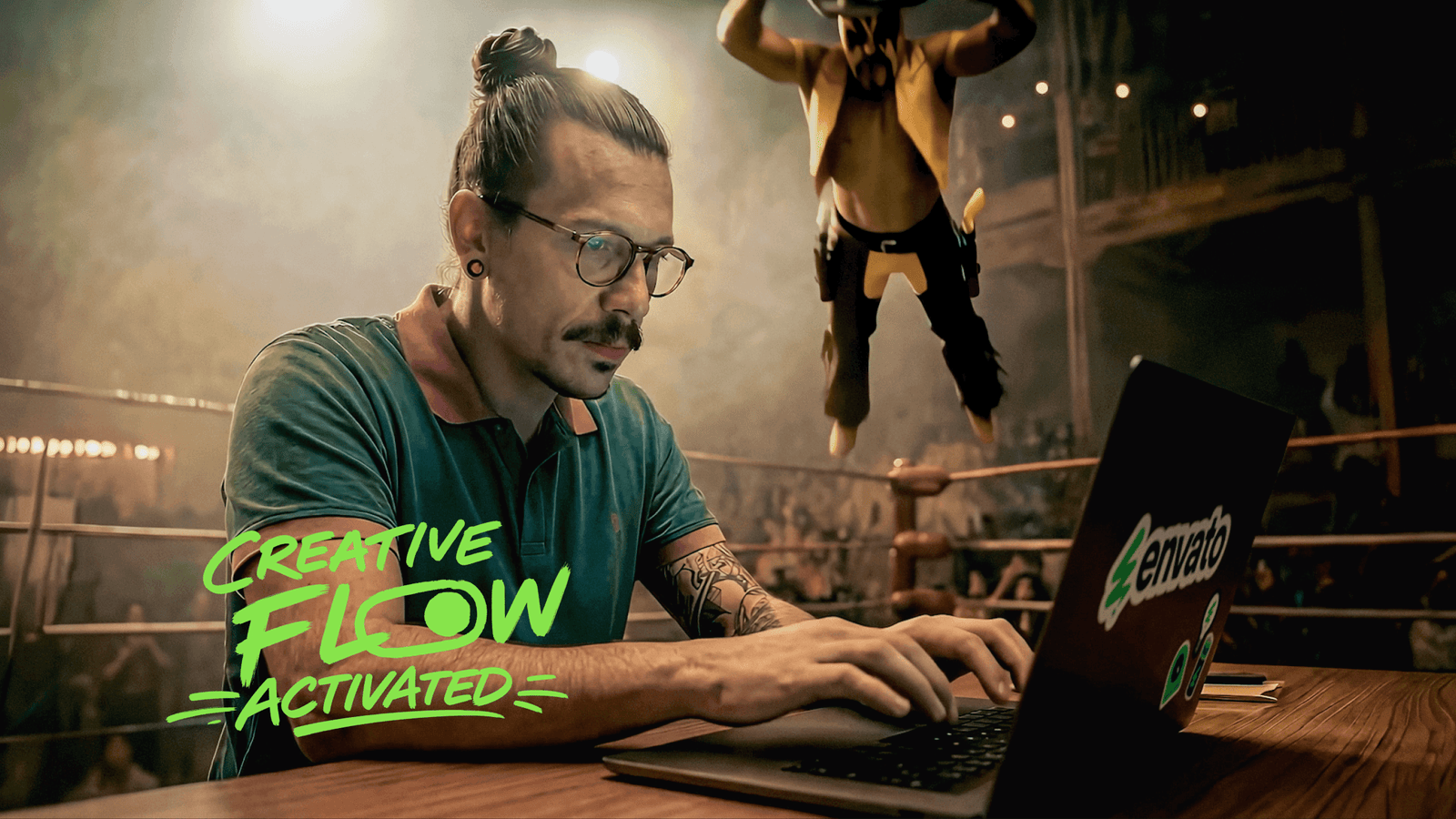
Most days don’t fall apart because the work is hard. They fall apart because the work keeps getting interrupted. A stock site here, a generator there, a font marketplace somewhere else, three subscriptions you’ve forgotten the passwords to. By the time you’ve found the right asset, wrestled with a separate generator, exported the file, and re-opened your editor, the idea you had twenty minutes ago is a faint outline of itself.
A good creative workflow with AI should solve that, not add to it. Done right, it collapses the asset hunt, the generation step, the edit, and the export into one continuous motion. Done wrong, it’s just one more tab.
This piece walks through what staying in flow actually looks like, end to end, for two of the disciplines we hear from most: graphic designers and video pros. Different work, same goal — get from brief to delivery without bleeding out into eight platforms along the way.
Flow gets talked about like a meditation state. For working creatives it’s more prosaic: you’re in flow when the tool stops being something you think about. The friction layer goes quiet. You’re moving between decisions — composition, pacing, color, rhythm — instead of between apps.
What breaks it is almost never the creative problem. It’s the production tax. Searching three libraries for the right shot. Switching to a generator to make the one element you can’t find. Coming back to your editor to drop it in. Realizing the license is wrong. Going back. Re-exporting. By then, the part of your brain that was actually solving the brief has wandered off to make coffee.
The point of an integrated creative asset toolkit isn’t to do the creative work for you. It’s to keep the production tax low enough that the creative work stays in the foreground.
Two scenarios, both familiar.
Friday afternoon, a deck for a Monday pitch. A wellness brand wants a moodier, more grown-up direction than their current visual identity. You need a hero image, three supporting visuals, a typeface that doesn’t look like every other wellness brand on Instagram, and a couple of mockups so the founders can see it on packaging.
The old version of this Friday: open a stock site, search “moody wellness,” find nothing that isn’t a woman in a linen robe looking pensively at a candle. Pivot to AI. Open a separate generator. Burn an hour learning the prompt syntax. Get something close. Realize you also need a font. Open a font marketplace. Realize you need mockups too. Open another tab.
The flow version of this Friday: use Looks Like Search to find references by image — drop in a frame from a magazine spread, get visually similar results back. Two of them are close enough to be the starting point. For the third, open Envato’s AI image generator without leaving the page, prompt the direction you want, generate a few variations. Pick one, send it back into the editor with precision masking to clean up the background. Browse fonts in the same catalog — with the new font preview tool, type your actual headline straight into each option before downloading. Generate the packaging mockup with AI — drop in the label, get a photorealistic product shot in seconds, no Photoshop warping, no shadow-matching, no half-hour detour. Export.”
The pitch is still hard. The judgment about which direction is right is still all you. But the production layer didn’t fight you for it.
A client wants the same launch concept resized and remixed for Instagram, LinkedIn, TikTok, and a couple of out-of-home placements. Different aspect ratios, different copy, different supporting imagery for each.
The friction here isn’t finding the assets. It’s the repetitive work of remaking the same idea ten times. A creative workflow with AI earns its place by handling the variations — generate a hero asset, then use Envato’s Generative Fill to extend the background for a vertical crop, swap a detail for the LinkedIn version, regenerate a different supporting image for the OOH placement at a different aspect ratio. The creative call — what the campaign actually says — stays yours. The mechanical reformatting work doesn’t eat half your week.
What ties both scenarios together is that nothing in them required leaving the workspace. The stock library, the AI tools, the fonts, the mockups, the licensing — all in the same place, on the same subscription, with the same one-click license that covers everything you just made. Workspaces hold the whole brief together as a project board — every asset you’ve shortlisted, every variation you’ve generated, sitting in one place until you’re ready to license and download in bulk.
For more on which AI image tools fit different parts of a designer’s day, our breakdown of the Envato AI toolkit has you covered.
Video work has its own version of the same problem, and the production tax is heavier because there are more moving parts. Footage, music, sound effects, motion graphics, voiceover, transitions — every one of them historically lived on a different platform.
A SaaS client wants a 90-second explainer. Live-action footage for the human moments, motion graphics to walk through the product UI, a music bed that doesn’t sound like every other SaaS explainer, a voiceover, sound design for the UI animations, and lower thirds for the team intros. Six categories of assets for a 90-second cut.
The old version: a stock footage subscription for the live action, a separate music library, a motion graphics marketplace, an AI voiceover tool with its own credits system, a sound effects site, and your editor in the middle of all of it. Six logins, three invoices, four different license terms to keep track of.
The flow version: pull the live-action shots from the same catalog you pulled the motion graphics from. Use AI music suggestions to surface tracks that match the energy of the cut you’ve already started — moody opener, building under the demo, lifting for the close. Or generate a custom bed in Envato’s AI music generator if you want something totally custom. Generate the voiceover in Envato’s AI voice generator, keep the read, drop it on the timeline.
For the UI sound design — the taps, the notification chimes, the subtle whooshes that sell the product demo — Envato’s AI sound generator turns a text prompt into a usable clip in seconds, with five variations to pick from and a length anywhere between one and 22 seconds. Lower thirds, LUTs, and the VFX elements that punctuate the demo come from the same catalog too — templates you customize once, color grades that match across every clip, no plugin hunt. Export. License everything in one click.
The cut is the cut. The decisions about pacing and music choice and where the demo lands are still yours. What changed is that you spent the afternoon making those decisions instead of managing six subscriptions.
The client loved the explainer. Now they want a 15-second vertical version for paid social, a 30-second cut for YouTube pre-roll, and a 6-second bumper. Three new edits from the same source material.
This is where a creative workflow with AI either earns its place or doesn’t. For any AI-generated clips in the cut, Envato Reframe handles the aspect ratio shift — it covers seven ratios (16:9, 9:16, 1:1, 4:3, 3:4, 21:9, 9:21), uses prompt-guided outpainting to intelligently extend the scene rather than crop or stretch, and preserves the audio. The reel, the YouTube cut, and the bumper come from a single source generation rather than three regenerations. Drop in an animated subtitle template from the catalog for the silent-autoplay versions — the styled caption work that used to mean a separate plugin is already there as a project file you customize once. Music gets a shorter loop. Sound effects stay. Export, license, ship.
Both video scenarios benefit from the same underlying thing: a single catalog deep enough across categories that you’re not bouncing out of the editor to find the one specific element you need. The recent Seedance 2.0 update brought higher physical realism to the AI video generator, which matters specifically when you need a generated shot to cut against live action without looking like it came from a different planet.
Envato’s Beyond Adoption: The State of AI in Creative Work 2026 report, which surveyed nearly 1,800 creative professionals on the state of AI in creative work, found that almost half now use AI daily in client work — though nearly 70% don’t feel fully prepared for an AI-driven future. The split matters. The people getting the most out of these tools aren’t the ones treating AI as a shortcut or a threat. They’re the ones who’ve figured out which parts of their workflow it actually fits, and which parts it doesn’t.
The underlying psychology holds up too: research on flow at work consistently finds that the single biggest predictor of flow isn’t talent or motivation — it’s the absence of interruption. Which is the whole argument for keeping the tools in one place.
Friction is the thing standing between most creative pros and their best work. Not lack of ideas. Not lack of skill. The mechanical, repetitive, tab-switching, license-checking, subscription-juggling production tax that quietly eats hours every week.
Envato is built for the version of the day where that tax goes away. One catalog deep enough across categories that you stop bouncing between platforms. AI tools that sit in the same workspace as the stock, so generating, editing, and downloading are one continuous motion. One license that covers everything you make. It’s the toolkit for the people who care enough about the work to want everything in one place — and obsessive enough to notice when it isn’t.
The next brief that lands on your desk is the test. Run it through one place, end to end, and see what the day actually feels like when nothing pulls you out of it.
It’s a working process that combines stock assets, generative AI tools, and editing in one continuous flow — so a designer or video pro can move from brief to delivery without switching between platforms.
Envato includes access to an AI image generator, AI image editor, AI video generator, AI music generator, AI voice generator, AI sound generator and AI mockup generator, alongside the stock asset catalog.
Footage, music, sound effects, motion graphics, AI voiceover, and AI video generation all live in the same catalog. Video pros can build, score, and finish a cut without leaving the workspace or managing multiple subscriptions.
Just like with Envato’s stock assets, every Envato AI generation comes with a simple, lifetime commercial license.. You can use what you create commercially without separate permissions.
No. The judgment, taste, and creative direction stay with the creative pro. AI handles the repetitive or variable parts of production — generating variations, extending backgrounds, producing voiceovers — that the creative chooses to delegate.
By keeping stock photos, fonts, mockups, AI image generation, and AI editing in one place with one license, designers skip the tab-switching and licensing checks that eat hours across a typical week.
For most working creative pros, yes. The catalog covers stock photos, video footage, music, sound effects, fonts, templates, mockups, motion graphics, and the AI toolkit — with one commercial license that covers everything downloaded or generated.
The quality still depends on the creative pro’s judgment. AI changes the production speed and the range of options available at each step, but the final call on what ships is still entirely human.
Discover how Envato's AI sound generator creates custom sound effects from text prompts so creators can skip library searches and edit faster.

We tested 9 AI image generators on identical artistic prompts (same style-transfer task, same day) to see which one actually paints like an artist.
AI isn't making full movies yet; it's reshaping VFX, editing, and dubbing. Here's where it helps filmmakers today, and where it doesn't.

A practical, step-by-step guide to making a short AI film — from script and shot lists to character consistency, voice, sound, editing, cost, and legal rules.