Envato: Get every type of asset for any type of project, and access to AI tools. Start now

The best AI art prompts for abstract art

Abstract art is the hardest genre to prompt — and the most rewarding once you know how.

David Allegretti 10min read
The best AI art prompts for abstract art

Most AI art prompts start with a subject. A person, a place, an object — something concrete for the model to anchor to. The prompt formula that works for nearly everything else (subject + style + lighting + mood) falls apart the moment you try to create abstract art, because the entire point of abstraction is that there is no subject. There’s composition, color, texture, movement, tension, balance — but nothing the model can point a camera at.

That’s why “abstract colorful painting” produces visual noise. The model has no constraints, so it defaults to every abstract image it’s ever seen, averaged together. The result is technically abstract but aesthetically meaningless — the AI equivalent of throwing paint at a wall and calling it art.

The best AI art prompts for abstract art work differently. Instead of describing what’s in the frame, they describe how the frame is organized: the relationships between shapes, the behavior of color, the quality of edges, the weight of negative space. This guide breaks down the prompting approaches that produce intentional, sophisticated abstract compositions — organized by sub-style, because a geometric Mondrian-influenced piece and a gestural de Kooning-influenced piece require completely different prompt strategies.

If you’re looking for the general prompt framework first, our complete guide to AI art prompts covers the fundamentals. This piece goes deeper on the specific challenge of abstraction.

Why abstract art needs more specificity, not less

There’s a common assumption that abstract art prompts should be vague — that ambiguity gives the AI creative freedom. The opposite is true. When you’re working with representational imagery, the subject itself provides enormous amounts of implicit information. “A woman in a red dress” tells the model about form, proportion, color, scale, and spatial relationships without you needing to specify any of them.

Abstract art strips all of that away. Without a subject, every visual decision — palette, composition, texture, contrast, edge quality, spatial depth — needs to come from the prompt or it gets decided by the model’s statistical average. And the statistical average of all abstract art ever made is a muddy, mid-contrast, vaguely colorful rectangle. Not what you’re after.

The fix is constraining the model with the specific abstract vocabulary that matches what you’re actually trying to create. The tighter your visual brief, the more intentional the output. Let’s break that down by sub-style.

AI art prompts for abstract art by sub-style

Geometric abstraction

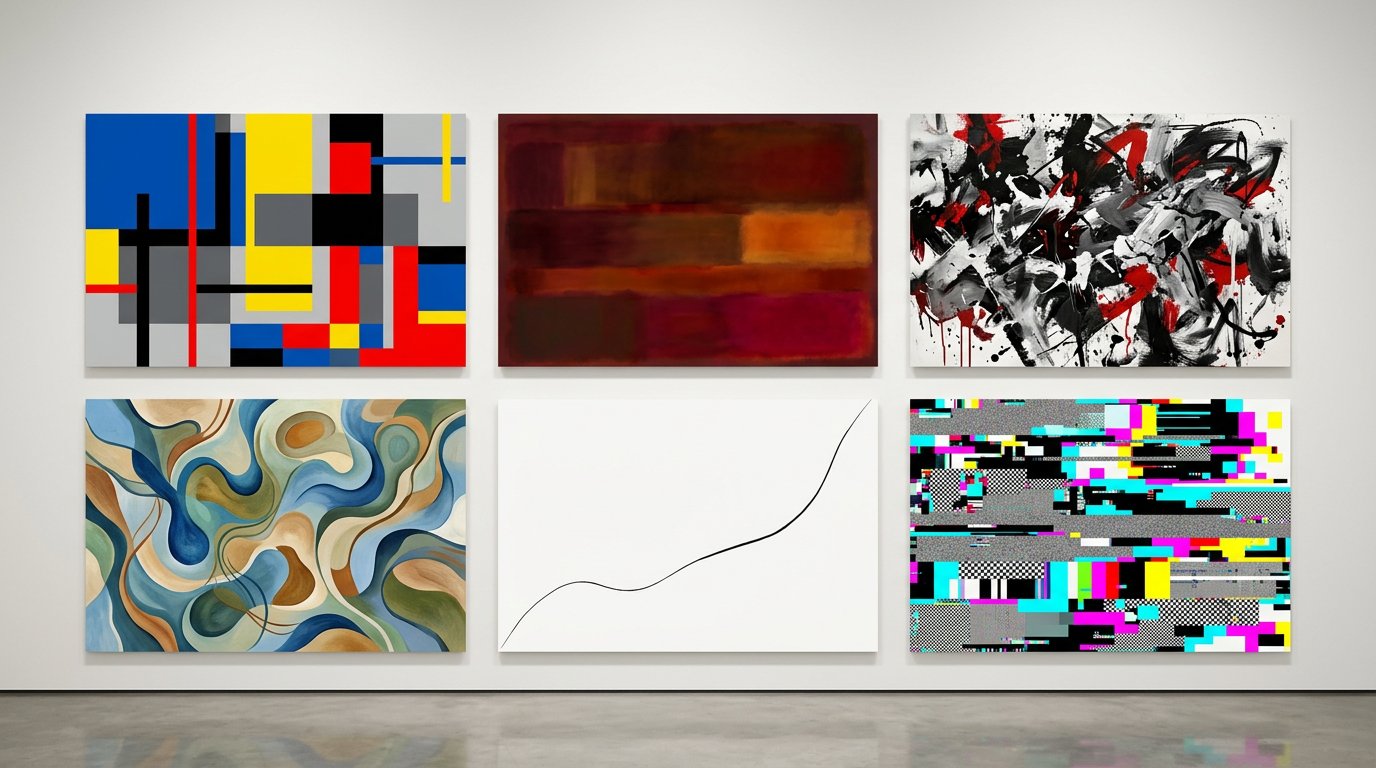
Precise shapes, clean edges, mathematical relationships. Think Mondrian, Malevich, early Kandinsky, or contemporary hard-edge painting. The prompting challenge here is getting the AI to commit to precision — models naturally soften edges and blend transitions, which undermines the entire aesthetic. Your prompt needs to explicitly demand hard edges, clean geometry, and disciplined negative space.

Prompt example: “Geometric abstract composition, overlapping translucent rectangles in navy blue, coral, and matte gold, clean hard edges, asymmetric grid layout, generous white negative space, flat color with no gradient, modern gallery art, high contrast”

Prompt example: “Horizontal bands of alternating matte black and warm cream, varying widths, precise parallel edges, single thin vermilion line breaking the pattern off-center, minimalist geometric abstraction, print-quality resolution”

The keywords that matter most: “hard edges,” “flat color,” “no gradient,” “precise geometry,” “negative space.” These override the model’s instinct to soften everything.

Color field

Large expanses of color that create atmosphere through hue, saturation, and subtle variation rather than form. Rothko, Helen Frankenthaler, Morris Louis. Color field painting is about the emotional weight of color itself — the way a deep cadmium red rectangle hovering above a dark umber feels heavy, warm, and charged. These are some of the most deceptively simple compositions to prompt, because the visual simplicity requires extremely precise color language.

Prompt example: “Color field painting, two large horizontal rectangles stacked vertically — deep cadmium red on top, dark burnt umber below — soft feathered edges where the two colors meet, subtle luminous glow from within, matte canvas texture visible, meditative and heavy, Rothko-influenced atmosphere”

Prompt example: “Washed color field, diluted cerulean blue bleeding into raw canvas, uneven saturation, pooling pigment at lower edge, stain painting technique, transparent watercolor-like quality on unprimed cotton, Helen Frankenthaler influence”

Limit your palette to two or three colors maximum and name them specifically. “Blue and red” gives the model too much latitude. “Cadmium red and burnt umber” anchors the output in a specific tonal range.

Gestural and abstract expressionism

Energy, movement, visible evidence of the artist’s physical process. De Kooning, Franz Kline, Joan Mitchell. The prompting challenge here is the opposite of geometric work — you need to communicate chaos and spontaneity within a structured prompt. The key is describing the physical behavior of paint rather than the shapes it forms: drips, splatters, aggressive brushwork, thick impasto, scraping, layering.

Prompt example: “Abstract expressionist painting, aggressive gestural brushstrokes in titanium white and cadmium yellow over a dark charcoal ground, thick impasto texture with visible palette knife marks, paint drips running vertically, raw energetic composition, large-scale canvas feel, Franz Kline meets de Kooning”

Prompt example: “Action painting, layers of black ink splattered and thrown across raw canvas, controlled chaos, calligraphic energy in the mark-making, some areas of exposed canvas showing through, dynamic diagonal movement, monochromatic with accents of deep red”

Movement references like “diagonal energy,” “centrifugal composition,” or “sweeping arcs” help the model create directional flow rather than scattered randomness.

Organic and biomorphic

Soft, natural forms that suggest biology without depicting it literally. Arp, early Miró, contemporary artists working with fluid dynamics and cellular structures. These compositions feel grown rather than constructed — rounded edges, flowing contours, forms that seem to breathe or pulse. The prompting approach leans on natural metaphors: cellular, amorphous, undulating, membrane-like.

Prompt example: “Biomorphic abstract composition, soft amorphous shapes in muted sage green and warm terracotta floating against a pale cream background, rounded organic forms suggesting cellular structures, translucent overlapping areas, gentle shadows creating depth, mid-century modern aesthetic”

Prompt example: “Fluid abstract art, marble-ink effect with swirling veins of deep indigo, copper, and ivory, organic flow patterns suggesting geological strata, high contrast between opaque and translucent areas, rich surface texture, macro close-up perspective”

Minimalist abstraction

Reduction to essentials. Agnes Martin, Donald Judd, Ellsworth Kelly. Minimalist abstraction is about what you leave out — the tension created by a single line on an empty field, or three rectangles of slightly different proportions arranged with careful asymmetry. The prompting discipline here is restraint: describe very little, but describe it with total precision.

Prompt example: “Minimalist abstract, single thin horizontal line in graphite grey crossing a large off-white canvas at the lower third, barely visible pencil texture, vast empty space above, quiet contemplative tension, Agnes Martin influence, matte finish”

Prompt example: “Three rectangular blocks of flat color — dusty rose, slate blue, warm ochre — arranged with deliberate asymmetric spacing on a white ground, hard edges, no texture, no shadow, Ellsworth Kelly-influenced, clean and decisive”

The temptation is to add more to the prompt. Resist it. With minimalist work, every element you add dilutes the composition. Describe two or three elements with extreme precision and let negative space do the rest.

Glitch and digital abstraction

Artifacts, distortion, data corruption, pixel displacement — the aesthetic of broken digital systems treated as visual material. This sub-style works well with AI because the models have seen glitch art in their training data and can reproduce the specific visual characteristics: scan lines, RGB channel separation, compression artifacts, mosaic displacement.

Prompt example: “Digital glitch abstract, fragmented portrait dissolving into horizontal scan lines and RGB channel separation, corrupted pixel blocks in hot pink and electric blue against black, data moshing effect, VHS tracking distortion, contemporary digital art”

Prompt example: “Abstract data visualization, flowing particle streams in white and pale cyan against deep black, mathematical curves suggesting gravitational fields, subtle noise texture, generative art aesthetic, high-resolution crisp detail, serene and computational”

Prompting principles for abstract work

Across all sub-styles, a few principles consistently produce better abstract output.

Name your colors specifically. “Cerulean blue and burnt sienna with gold leaf accents” produces dramatically better results than “blue and brown.” Specific pigment names anchor the model in a tonal range because those names appear in art-world training data alongside specific visual references.

Describe edges and transitions. Hard edges versus soft edges, sharp versus feathered, precise versus blurred — edge quality is one of the most important visual characteristics in abstract art and one of the most overlooked in prompts. A composition of hard-edge geometric shapes reads completely differently from the same shapes with soft, atmospheric transitions.

Specify the role of negative space. “Generous white space,” “crowded composition with no breathing room,” “forms floating in empty field” — the relationship between mark and space is often what makes abstract art work or fail. Don’t leave it to the model.

Reference artists or movements, not just adjectives. “Rothko-influenced” carries more visual information than “meditative and colorful,” because the model has seen Rothko’s work and understands the specific compositional grammar. Use artist references as shorthand for complex aesthetic instructions, not as requests for copies.

For more on how color, medium, and style keywords shape AI output across all genres, our comprehensive AI art prompts guide covers the full framework. The style presets in Envato’s AI image generator are also worth experimenting with for abstract work — presets that target specific aesthetic movements can set a tonal baseline before your prompt adds compositional detail.

Using Envato’s tools for abstract art

Abstract art generation works across both of Envato’s AI creation tools, but they serve different purposes.

Envato’s AI image generator handles complex compositions, textural depth, and photorealistic rendering of physical media (oil paint, ink, canvas texture). It’s the right tool when you want abstract art that looks like it could hang on a wall — visible brushstrokes, surface texture, the physical behavior of paint. The model routes your prompt automatically to whichever engine handles the visual characteristics you’ve described, so you don’t need to worry about which underlying model produces the best abstract output.

Envato’s AI graphics generator produces cleaner, more designed output — flat vector aesthetics, sharp edges, consistent color fields. It’s better suited to geometric abstraction, minimalist compositions, and abstract work destined for graphic design applications (backgrounds, patterns, brand visuals, presentation decks). If the output needs to sit alongside typography and layout elements rather than hang as a standalone piece, the graphics generator is usually the better starting point.

Both tools include the ability to iterate quickly — generate multiple variations from the same prompt, compare directions, and refine. Abstract art benefits from this iteration more than most genres, because the gap between “not quite right” and “exactly right” is often a single color shift or a compositional rebalancing. Generate four or five versions, find the one that’s closest, and refine from there. You can also take a promising generation into Envato’s AI image editor to adjust specific regions without regenerating the whole composition.

Every asset you generate comes with a lifetime commercial license — which matters for abstract work specifically because these compositions often end up as background textures, brand elements, print-on-demand products, and wall art. The license covers all of those uses, even after cancellation.

AI art prompts for abstract art FAQs

Related Posts