50 best PowerPoint templates for 2026: education, business & more
Explore PowerPoint templates with professionally designed layouts to create polished, modern, and visually cohesive presentations.
Envato: Get every type of asset for any type of project, and access to AI tools. Start now
Trying to choose between product design and UX design? Read on to learn everything you need to know about both design disciplines and figure out the best fit for your skill set.
Whether launching a new product or enhancing an existing one, any designer aims to create an intuitive design that gives the end user a smooth experience. UX and product designers are equally important in this process, and there is some natural overlap between their roles.
Although these terms are often (incorrectly) used interchangeably, there are a few essential distinctions between product and UX design. In this post, we’re going to explore that difference at length.
We’ll cover the basics of both design disciplines to help you develop a thorough understanding of their purposes and functions and give you some handy pointers for figuring out which is a better fit for your career. Let’s dive in!
Short for ‘user experience,’ UX design is about crafting an ideal experience for your product’s users so they can make the most of it and use it intuitively.
Good UX design should make products as user-friendly as possible and help your audience connect with your product. UX design goes beyond creating a good UI (user interface) – it should incorporate all aspects of the user experience.
UX designers’ work begins before completing a product, as they’re involved in its design from the get-go. For example, the Airbnb app has a very strong UX design: its website is visually appealing, easy to navigate, and engaging without being cluttered, providing customers with a great experience when they click on the site.

Unlike UX designers, product designers take an existing product and adjust, change, or redesign it. They do this to appeal more strongly to target demographics or improve the product.
Product design often involves many of the same things as UX design since a sound product should also be user-friendly and intuitive. However, product designers’ roles typically extend beyond those of a UX designer since the former have to work with all product elements instead of only the user-facing ones.
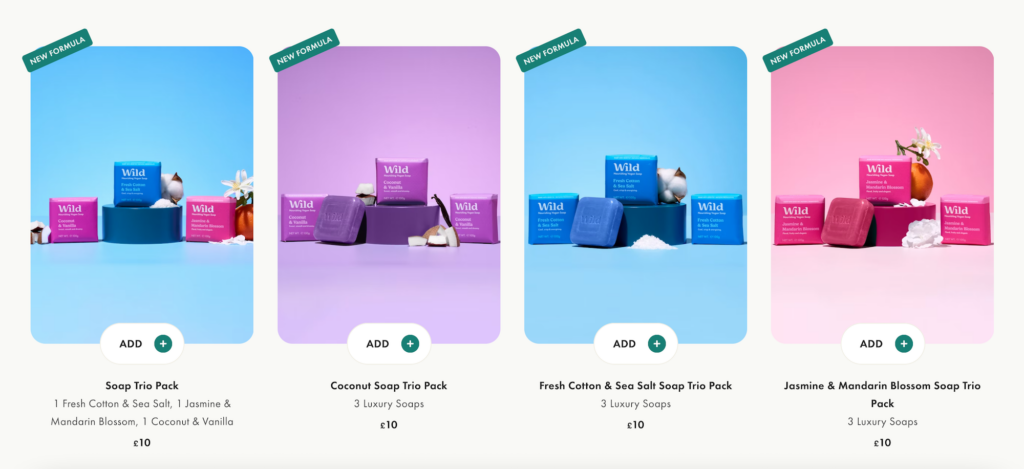
Wild deodorant is an excellent example of product design and reworking an existing product to expand its appeal. Their range of scents for sensitive skin is just as appealing as their traditional range, except that they now cater to a new subset of prospective customers, helping them draw in more leads without creating a brand-new product.
There’s a reason people often compare product and UX design; after all, they’ve got the following factors in common.
Both product and UX designers must consider how the final product will affect users.
Additionally, both design approaches rely on extended user research, as you can only appropriately tailor a product to its future (or current) users if you have all the facts.
Iterative design – which involves improving the design or process in cycles – is crucial to both UX and product design, as both approaches center on enhancing a product over time to better appeal to its intended audience.
If you enjoy collaborating with a wide range of stakeholders, you’ll be well suited to both product and UX design. Both jobs work closely with many other channels to optimize the final product.
There’s no need to be an all-around expert; instead, these roles involve knowing how to work with several individual experts and groups in your company.
Tweaking products to suit their users perfectly can take much work and problem-solving. Product and UX design both, as a result, rely on creative thinking and strong problem-solving skills.
Looking at a challenging situation and thinking of original approaches and potential solutions is great for both product and UX design.
While UX and product design share many similarities, they’re also very different. Here are some of the main discrepancies between UX and Product Design.
While product design focuses on improving facets of an existing product, UX design is all about creating user-friendly features from scratch. As a result, both processes have very distinct concept development processes.
UX designers often come up with the initial concepts. In contrast, product designers generally take those concepts and fine-tune them to suit both the customer’s and the company’s needs.
While both roles focus on putting customers first, a product designer’s output is to improve what already exists: optimizing a product by picking apart where it can be improved to reflect the customers’ wants better.
Meanwhile, a UX designer’s output focuses on connecting with customers and ensuring that the product’s design incorporates customer needs
A UX designer will often take a more abstract concept – like a business system or online marketplace – and suggest ways to make it suit its users.
Product designers, meanwhile, will mostly deliver suggestions for improvement. For example, they’ll look at their company’s hosted phone system and devise creative ways to make it easier.
So, you’re up to speed on the differences between UX and Product Design. But, knowing what both types of design look like doesn’t necessarily mean you know which one is a better fit for you. The following considerations might help you narrow this down.
Typically, a UX designer will be in charge of the following:
As a UX designer, it’s worth showcasing your previous projects and designs in a portfolio that highlights the above expertise and your abilities to create exceptional user experiences. A well-crafted UX designer portfolio can be a powerful tool in demonstrating your skills to potential employers or clients.
A product designer will usually be responsible for the following:
While it’s not the only thing separating the two, salaries can be a deciding factor if you’re still deciding which one to go for. In 2021, Glassdoor reported that UX designers made an average of $95,944 yearly, while product designers earned around $105,448.
As you can see, both professions promise strong earnings, though product designers have a slight edge over UX designers.
Despite their similarities, product and UX design each comes with its own demands, challenges, and rewards. To learn more about becoming a UX designer, check out this article on UX learning pathways. Or, head to Envato Elements to start creating today!
Explore PowerPoint templates with professionally designed layouts to create polished, modern, and visually cohesive presentations.
Learn what font Nike uses, explore its typography evolution, and discover Nike font alternatives to create bold, minimal, high-impact designs for branding and campaigns.
Discover bold music video fonts for 2026, with top picks and bonus styles that help creators match sound, genre, and mood with striking visual identity.
Learn how to create an AI infographic design using GraphicsGen and Illustrator, from idea to reusable systems, with a step-by-step workflow for consistent, scalable visuals.