AI sound generator guide: How to create sound effects with AI
Discover how Envato's AI sound generator creates custom sound effects from text prompts so creators can skip library searches and edit faster.
Envato: Get every type of asset for any type of project, and access to AI tools. Start now
How do you direct an actor who doesn't exist? Robert Gaudette spent months protecting the gentleness of a man made of pixels — throwing away flawless shots because Marcel wouldn't have moved that way — until a theater full of strangers went quiet for someone who was never there.
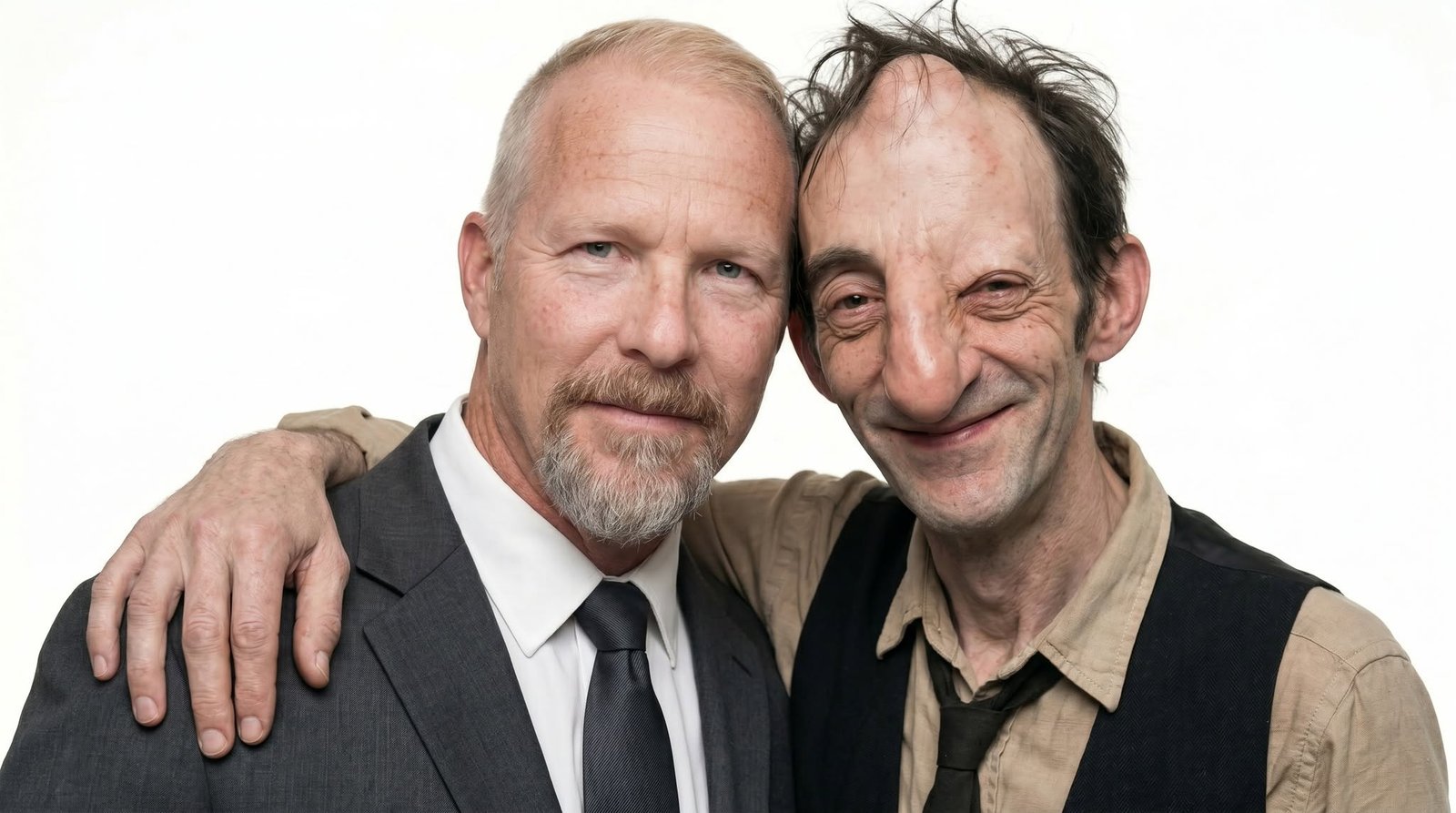
For decades, Robert Gaudette wrote stories nobody would ever see. Twenty-five, maybe thirty scripts, sitting in a drawer in Welland, Ontario — no film school, no industry connections, no budget, no way in.
Then the way in arrived. His film, A Face Only a Mother Could Love, an eight-minute bittersweet fable about Marcel — a man the world refuses to look at, who dances alone in his Paris kitchen every night, certain that love will one day arrive — has just completed one of the most remarkable runs in the short history of AI filmmaking: the Runway Grand Prix, Best AI Film at the New York International Film Awards, and now the Best Picture Award at OMNI 1.5: HYPERPHANTASIA, presented by Envato, where a jury led by Alex Proyas chose it from more than 3,800 entries worldwide.
What makes Robert’s story worth your next ten minutes isn’t the trophy count. It’s that everything he says about making the film — protecting a character’s gentleness across hundreds of failed generations, curating instead of generating, learning that “prompting is not directing” — is really about the part of filmmaking no tool can do for you.
Watch the film, then meet the man who made it.
Envato: Let’s start with an introduction. For readers meeting you for the first time — who is Robert Gaudette, and where in the world are we finding you?
Robert: I’m a Canadian AI filmmaker, writer and former photographer living in Welland, Ontario, near Niagara Falls. I came to filmmaking in a very roundabout way. I worked in technology, spent years as a photographer and later worked in the non-profit world. But through all of that, I was always writing stories.
I didn’t go to film school, I didn’t have industry connections, and I didn’t have access to the sort of budgets filmmaking normally requires. For a long time, the stories just sat there. These new tools finally gave me a practical way to start making them.
I still feel quite new to all of this, to be honest. A lot has happened very quickly.
Tell us a bit about yourself as an artist. How has your work and art evolved over the years, from your beginnings to today?
I started as a photographer, but I was never especially interested in making polished or perfect images. I was more drawn to emotion. Unusual faces, awkward gestures, skin texture, and moments where someone seemed emotionally exposed.
Even when I worked around fashion, I usually found myself moving away from the flawless version of things. I liked photographs that felt a little raw or uncomfortable. Sometimes the grain or imperfection was the most honest part of the image.
Over time, I started wondering about the person inside the photograph. What had happened before that moment? What were they thinking? What were they carrying around with them? That eventually pushed me toward writing and film.
The medium has changed, but I don’t think my interests have changed very much. I’m still drawn to people who might be overlooked and to finding something tender or beautiful where others may not immediately see it.
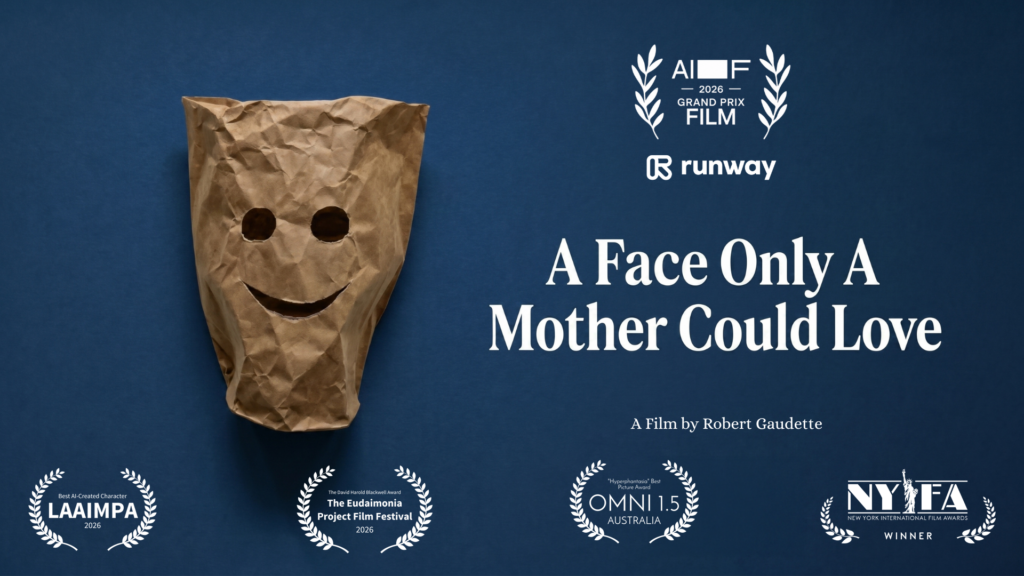
For anyone who hasn’t seen it yet, how would you describe A Face Only a Mother Could Love in your own words?
It’s a small, bittersweet love story about a lonely man named Marcel who lives in Paris and has spent most of his life being judged by the way he looks. His mother told him every morning that he was beautiful, and he believed her. The rest of the world treated him very differently, but it never completely managed to take that belief away from him.
Every evening, Marcel gets dressed, prepares his home and dances with the woman he hopes will one day come into his life.
It’s sad, obviously, but I don’t really think of Marcel as a tragic person. He still has hope. He still believes he is worthy of love. There is something very moving to me about the fact that the world has been unkind to him, but it has never managed to make him cruel or bitter.
Congratulations again — Best Picture from a field of more than 3,800 films. Where were you when you found out, and what was the first thing you did?
I was home when I found out. I remember reading the message a few times because I wasn’t completely sure I had understood it properly. I think I mostly stared at it for a while and tried to let it register.
I knew rationally the film had done well at the Runway Festival, but you still wonder if it was an anomaly or a one-off. The film had also had a number of rejections from other festivals, so you just never know what a jury is looking for.
The film had been such a solitary experience. For most of it, it was just me sitting at a computer, trying to make one small moment work, then the next one, then the next. I didn’t make it expecting any of this. It began as a personal experiment to see whether these tools could carry a human story.
So to hear that it had won Best Picture from more than 3,800 entries was honestly hard to take in. More than anything, I was happy that people had connected with Marcel.
Before all this, your working life spanned photography, technology and the non-profit world. What was your relationship with film and storytelling during those years?
My love of film and storytelling was always there. It was just happening quietly in the background.
I kept writing stories even though I had no obvious way to get them made. Photography taught me how to look closely at people and how to curate. Technology made me comfortable experimenting and solving problems. But my work in the non-profit world probably shaped me most as a storyteller.
I spent a lot of time with people who had been reduced to a label or defined by the worst thing that had happened to them. You might hear someone described as homeless, addicted, difficult or vulnerable before you ever met them. Then you would sit down with that person and discover someone funny, complicated, intelligent, and incredibly resilient.
That work taught me to look beyond the way someone was being described and try to see the actual person underneath. It taught me a great deal about empathy and about how much strength people can carry without anyone noticing. I think that experience is very present in Marcel.

You had decades of scripts sitting in a drawer — some 25 or 30 of them — and no way into the industry. Take us back to the moment you realized these new tools might finally get one of them on a screen. Why was Marcel’s story the one you chose?
At first, the tools were exciting because they could make an interesting image. That was fun, but it didn’t really feel like filmmaking yet.
The shift came when the video tools began showing signs of world building and performance. They were still unreliable, but I could suddenly see how they might be used to carry an entire story. The tools didn’t give me stories. The stories were already there. What they gave me was access to production.
I wish I could say Marcel was a perfectly strategic choice and that I had everything figured out from the beginning. I didn’t. This was a personal project — something I would use for marketing my AI services. It was only when it was finished that I thought I had something special.
I started with the idea of a lonely man in Paris and a love story about someone who had lived a difficult life. As I worked, Marcel gradually became more specific. His face appeared, then his posture, his gentleness and the slightly formal way he moved through the world. He revealed himself through the process.
His story was intimate enough for me to attempt on my own, but emotionally rich enough to test whether these tools could actually make an audience care about a person.
Marcel is a man the world has decided not to look at, raised by a mother who told him every morning he was beautiful. Where did the inspiration for the character come from?
Marcel wasn’t based on one particular person. Regardless of how you look, I think many people go through periods of feeling ugly or outcast. I could relate to this feeling — the gap between the perception of who you are and the reality of how you actually feel inside. That gap between the way someone is perceived and who they really are is something I’ve been interested in for a long time.
It was present in my photography, where I was drawn to unconventional imagery and forms of beauty that didn’t fit the usual ideal. And I saw it constantly in my non-profit work, where people were introduced through a label before you ever met the whole person underneath it.
The world does the same thing to Marcel. It sees his face and assumes it understands his entire story. His mother saw him differently. She gave him a belief in his own beauty that the rest of the world never quite managed to destroy.
I didn’t want the audience to pity him. I wanted them to stay with him long enough to see the person underneath.
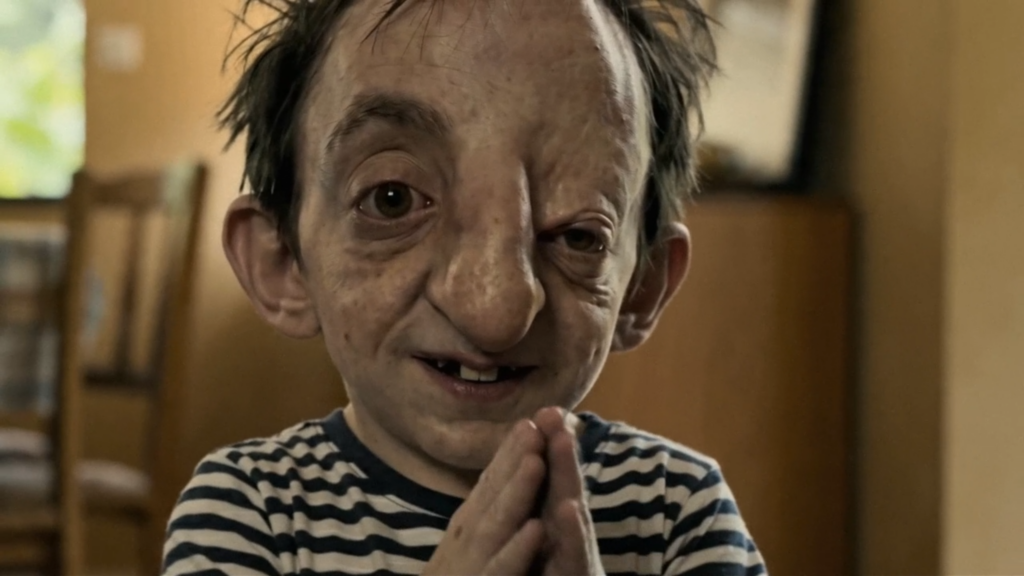
Judges and audiences keep singling out Marcel’s emotional continuity — he feels like the same soul in every frame, which is famously one of the hardest things in generative film. How did you achieve that, practically?
A lot of repetition, a lot of failed generations and a lot of throwing things away.
I created strong reference images for Marcel and kept returning to the same face, clothing, posture and lighting. But matching his appearance was only part of it. The bigger question was always, “Does this still feel like him?”
Sometimes I would get a shot that looked technically impressive, but Marcel moved too confidently, too aggressively or simply in a way that didn’t belong to him. So I wouldn’t use it. Once I understood that he was gentle, hopeful and slightly formal, my job was really to protect those qualities.
Editing and sound helped a great deal too. Emotional continuity isn’t really about making every frame identical. It’s about choosing the gestures, expressions and pauses that feel as though they come from the same inner person.
The nightly waltz in the kitchen is the image everyone leaves with. Was that in the script from day one, or did it emerge in the making?
The idea of Marcel dancing with an absent partner was there very early. It was such a simple way to show both his loneliness and his hope without having him explain either one. The details developed while I was making it.
What became important was that he wasn’t just dancing alone. In his mind, someone was really there. He leaves space for her. He guides her. He reacts to her. He has been practising because he believes he should be ready when love finally arrives. That changed the scene for me. It made it tender rather than simply sad.
I also loved the idea that his ordinary kitchen becomes a ballroom for a few minutes every evening. This is how Marcel coped. The outside world has decided who Marcel is, but inside that room he gets to imagine another version of his life.
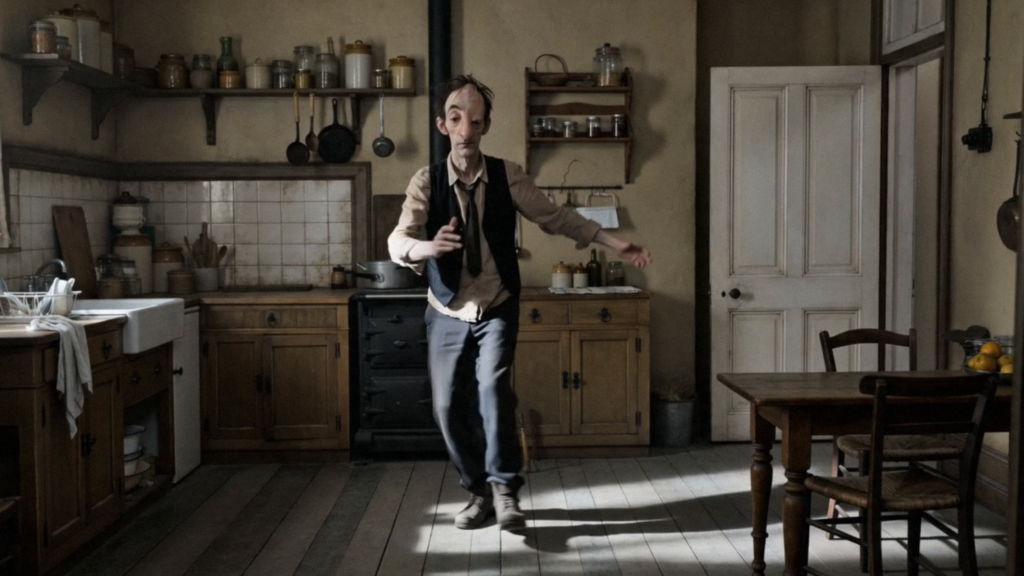
Viewers have compared the film’s look to Gondry, Kaufman and even Wes Anderson. Who were you actually drawing on — in cinema, photography or elsewhere?
Jean-Pierre Jeunet was probably the clearest influence. I’ve always loved the way his films can be funny, strange, romantic and sad at the same time. They feel heightened, but the people still feel very human.
My photography was also a major influence, probably more than I realized at first. I was never interested in cleaning away every flaw. I liked texture, grain and a little discomfort. I think that carried into Marcel’s world. Even though the film is stylized, I didn’t want it to feel overly polished or synthetic.
There are probably traces of silent cinema, other films with heavy narration like Burton’s Big Fish, and all kinds of films and photographs I’ve absorbed over the years.
And I should probably admit that I’ve never actually been to Paris. It is my imagined version of Paris, built from photographs, films and whatever version of the city had collected in my head over time. Paris remains foreign, romantic and fantastical to me. Perhaps that helped it feel a little more like a fable.
You’ve described this way of working as “creative gambling.” Walk us through your workflow. What does your toolkit look like, where do stock assets, sound and music fit in, and how many generations can a single usable shot really take?
I usually begin in a fairly traditional way. There’s a script, a rough shot list and a sense of what the scene is supposed to feel like. Then I build the characters and environments as still reference images. Once I understand the world, I start trying to create movement and performance.
I also begin editing very early and keep a rough assembly that I can review as I move forward. You can create a beautiful shot that simply doesn’t belong in the film. You only really understand that once you put it beside everything else.
I call it creative gambling because every generation is a wager. You can be very specific, but you never completely control what comes back. Sometimes a usable shot appears after a few tries. Sometimes it takes dozens. Sometimes the model gives you something strange that is better than what you planned. And sometimes a very simple action just refuses to work.
The process is completely hybrid. I use several generative tools, conventional image editing, a standard editing program, stock assets, sound design and music. I’m not interested in proving that I held creative mastery over everything you see and hear. I’m interested in making the scene work.

What skills from your previous careers transferred more than you expected — and what did you have to learn from zero?
Photography helped enormously, and not only with light and composition. It taught me how to look closely at someone and how much emotion can exist in a hand, a posture or a glance. It also taught me not to polish away the thing that makes an image interesting. Sometimes the flaw, awkwardness or discomfort is exactly where the feeling lives.
Technology taught me to experiment and not become too discouraged every time something failed, which is useful because things fail constantly in this process. And as I said, the non-profit work taught me empathy — that people are almost always more complicated, more surprising and stronger than the story being told about them. That has had a huge influence on the kinds of characters I want to create.
What I had to learn was how to sustain one of those characters across an entire film. A strong photograph is one thing. Creating a performance through movement, editing and sound, and convincing the audience that the same inner person exists from shot to shot, is something very different.
The biggest lesson has been that prompting is not directing. Directing is knowing who the person is beneath the image and recognizing when the result has lost them.
In a few months you’ve won the Runway Grand Prix, NYIFA’s Best AI Film and now OMNI’s Hyperphantasia Best Picture. It’s an incredible run — how are you feeling about it all, and what’s next for Robert Gaudette Creative Studio?
It’s been a lot to take in. Winning the Runway Grand Prix already felt far beyond anything I had expected. Then NYIFA and OMNI happened, and suddenly it felt as though people were responding to the film in a real way, not just to the fact that it had been made with AI.
One of the moments that stayed with me most was sitting in the theater while the film played and feeling the room become quiet. It felt as though people had stopped thinking about the technology and were simply spending time with Marcel. That meant a great deal.
I’m incredibly grateful for the awards, but I’m also trying not to get too carried away by them. The next film still has to work. You still have to sit down and solve every scene.
Robert Gaudette Creative Studio is now evolving into Nolia Studios — a new studio with Kirk Hipkiss as my partner. Kirk is a long-time veteran in production with a lot of knowledge and experience, and together we make a very strong offering to clients. I’m also developing new short films, longer-form projects, and I’m in talks to create feature-length films for other creatives.
I made this film alone because that was what I had available to me, not because I think working alone is better. I love to work with talented writers, actors, editors, artists and filmmakers. The right collaborators will always make the work stronger.
My goal is to make films people remember because they cared about a character or felt something unexpected. Ideally, the technology eventually becomes the least interesting part.
Last one: for the person reading this with their own drawer full of scripts, what would you tell them to do this weekend?
Don’t try to make the entire film. Choose one scene. Actually, choose one moment from one scene. Find the image that contains the reason you wanted to write the story in the first place. Create the character. Create the room. Try to make one shot.
Don’t spend the whole weekend comparing tools or watching tutorials. Pick something and start. The first attempt probably won’t look like the film in your head, but it will show you what the second attempt needs.
And learn to curate. Making images is becoming easier. Knowing which image belongs in your story is much harder. Study films, photography, art and literature. Develop your own taste. Share what you learn and learn from the people around you.
Most importantly, finish something small. Twenty finished seconds will teach you more than another year of waiting for the perfect conditions. The tools won’t solve the story for you, but they can finally give you somewhere to begin.
Got your own Marcel waiting in a drawer? Envato’s AI tools for video, image, music & more — plus 25 million+ creative assets — will help you bring your vision to life.
This interview has been lightly edited for length and clarity.
Find Robert on YouTube, LinkedIn and at robertgaudette.com.
Discover how Envato's AI sound generator creates custom sound effects from text prompts so creators can skip library searches and edit faster.

We tested 9 AI image generators on identical artistic prompts (same style-transfer task, same day) to see which one actually paints like an artist.
AI isn't making full movies yet; it's reshaping VFX, editing, and dubbing. Here's where it helps filmmakers today, and where it doesn't.
A practical, step-by-step guide to making a short AI film — from script and shot lists to character consistency, voice, sound, editing, cost, and legal rules.