How to edit with AI using Envato stock photos
Learn how to edit with AI on Envato stock photos, customizing images instantly by removing objects, changing backgrounds, and creating polished visuals without leaving the platform.
Envato: Get every type of asset for any type of project, and access to AI tools. Start now
Get your marketing plan on the right track by being clear about your target audience — the people your business intends to serve.

Whether you’re just kicking things off with your business or giving your marketing a much-needed glow-up, there’s one thing that makes all the difference: finding your people. Your target audience is the foundation of everything that follows.
In this guide, we’ll break down what a target audience really is and how creative marketers (especially those just starting out) can use that knowledge to build campaigns that actually connect.
We’ll share proven techniques to help you reach the right crowd and throw in a few extra marketing tools to keep you moving forward.
Simply put, your target audience is the group of people you’re making your products and services for. Other terms used to describe this group are “target market” and “target customer.”
For example, if you have a wedding photography business, a possible target audience would be newly engaged couples in your city.
A target audience analysis might not feel urgent when you’re just getting started. But if you skip it, you could be setting yourself up for bigger headaches down the road. Why? Because so many of your business decisions, from the branding to your messaging, depend on knowing exactly who you’re talking to.
Everyone running a small business has one question in mind: how do I score more sales and attract more customers? But, really, nailing your marketing strategy is where things often get messy.
And the numbers back this up. According to Constant Contact’s Small Business Now report (2025), 48% of new small business owners say customer acquisition is their top challenge. That means if you want to grow, you need to know exactly who you’re trying to reach.
This is especially true in creative fields, where your work is personal and your audience can feel wide open. A clear target helps you avoid creating for “everyone” and start speaking directly to the people who will be moved by your work.
So, where do you start? The first step is figuring out exactly who your offer is meant to connect with. Knowing your target customer inside and out gives you the insight to make smarter decisions.
A proper target audience analysis gives you clarity on things like:
In other words, understanding your audience influences everything, from how you market your offer to what your brand stands for (including your brand promise).
Now that you know why your target audience matters, it’s time to choose who you’re speaking to first. Start by narrowing in on the traits that define them.
If you’re a content marketer, this can mean thinking about the kind of people who’ll read your blog, watch your videos, or follow your brand’s social content. Are they beginners? Pros? Niche hobbyists?
Let’s have a look at how to discover different types of target audiences.
Demographics are the details you use to describe a specific group of people within a population. Some examples include:
You can also narrow down your audience based on where they live. That might mean focusing on a specific neighborhood, city, state, or even a certain distance, like people within 10 miles of your location.
For example, if you run a digital marketing business for customers or clients worldwide, you might not need to set up a location. After all, online brand management can be done remotely.
Still, it’s possible that as your business grows, you’ll see some cities or countries where most of your customers tend to come from. When that happens, you can put more energy into those areas or explore new ones that feel like a better fit.
Unlike demographics, psychographics are a bit trickier to spot from the outside. They’re more about personality and mindset.
Here are a few you can look at.
This might cover things like interests, hobbies, habits, or everyday activities. For example:
You can also specify what your ideal audience believes about a topic or issue. For example:
You don’t need to define every characteristic listed above, but it’s important to include at least two.
With only one, your target market becomes too broad, which makes it harder to create focused marketing. Including too many can make your audience so narrow that it limits your reach. Aim for a balance that gives you clarity without boxing you in.
Many market research tools (including some powered by AI) can help you make sense of these patterns faster. If you already have some audience data from your social dashboards or web traffic, AI tools can start highlighting what your top followers have in common.
Even after going through the steps above, you might still feel unsure about the audience you’ve chosen. That’s completely normal!
If you need a bit of extra help figuring out who your ideal audience is or want to learn more about them, these market research tools can make the process easier.
Facebook Audience Insights is a useful tool for exploring and refining your audience. You can filter by location, age, gender, interests, and language. Once you’ve set your criteria, the tool gives you insights like audience size, common demographics, and trends.
Let’s say you want to promote your comic-style illustrations in Dallas. You can select “Dallas” for location, and under “Interests,” select “comics.” Audience Insights then automatically reveals that Facebook users in Dallas who are interested in comics tend to be in the 25 to 34 age group.
There’s also a preference from the male members of that target market. Facebook also gives you an estimate of the size of the market: somewhere between 421,500 to 495,900 people.

Facebook Audience Insights is especially helpful for uncovering extra demographic and psychographic details to help you define your audience. It also gives you a general idea of how large that audience might be.
One caveat you should know about the data is that most of it’s based on users’ self-reported data and behaviors on Facebook only. This means that you shouldn’t treat it as 100% accurate, but it can give you a target audience analysis on a big-picture level.
If your intended audience doesn’t really use Facebook, then it might not be as useful to you.
Google Trends is a market research tool that shows you how interest in a topic or keyword changes over time. It’s a helpful way to spot what people are searching for and where those searches are happening.
Let’s say you want to promote your new board game online store in the United States. Type up board game-related keywords into Google Trends.

Google Trends can help you find the regions most interested in your topic.
You can then find out the top areas, cities, and states with the most interest in board games. You’ll also quickly see that interest in board games is seasonal, with August and May being the lowest interest points.
With this information, you can make decisions on the best time of the year to boost your business, the areas that are worth marketing to, and so much more.
While Google Trends isn’t AI-based, you can pair it with AI content tools to generate headlines, blog topics, or ad copy tailored to the regions where interest is strongest.
Claritas MyBestSegments has two free tools that can come in handy when defining your target market, as long as that market is within the United States.
Zip Code Lookup is most useful for businesses that want to target specific areas. Just enter a zip code in the form, and it’ll list the common marketing segments available for that area. You also get other demographic data breakdowns for the area, such as age, household income, household composition, and race and ethnicity.
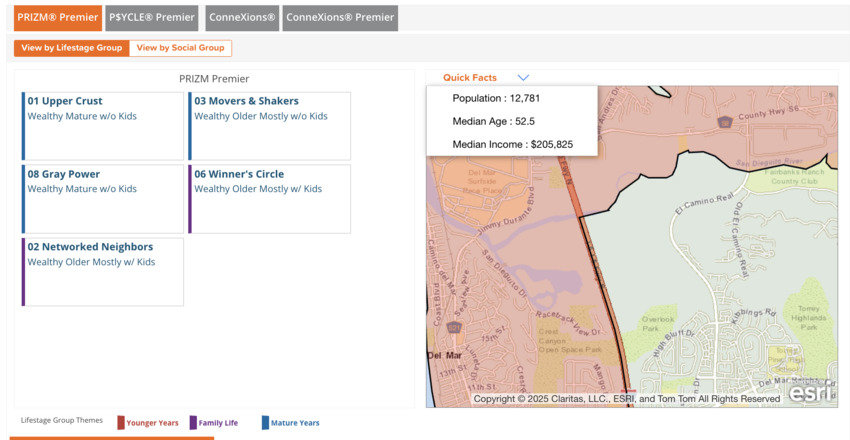
Don’t forget to click on the market segments in the results. This will give you more details about the other interests, behaviors, and demographics of that segment.
In the example below, the detailed view of the “Cruisin’ to Retirement” segment shows that they typically drive an Acura and eat at Italian restaurants (oddly specific, right?). This already gives you hints about potential marketing opportunities.

If you don’t want to search by location, you can also search by market segment and take it from there. You can head straight to Segment Details and pick a market segment close to the target audience you’ve chosen. The market segments are organized according to:

AI customer segmentation tools are growing and thriving. AI uses machine learning to sort your audience into data-backed groups. This means that instead of guessing who your best customers are, you can quickly spot behavior, preferences, and buying patterns.
Try AI customer segmentation tools to:
These are some tools that use AI for market research:
These tools work best when you’ve already learned some customer data, even if it’s just from a few sales or email signups. The more they learn, the sharper your segments get.
When you’ve got your target market locked down, planning your next steps gets a whole lot easier.
Hint: Start by writing a business plan or a marketing plan.
This is also the right time to test whether your audience is the right fit for what you’re offering. Here’s how you can start.
Know anyone who fits the group you’re targeting? Start there. Ask for honest feedback. Show them a few product photos or describe your services. Ask if they’ve bought something similar before, what mattered most to them, and what they wish had been better.
Pay attention to their response. You’re probably on the right track if:
If you don’t know anyone in your audience directly, look for communities that match. These might be:
Ask around! That’s the true secret to a winning market test.
An email list is a simple way to see who’s interested. Share it in relevant spaces or run a few ads. If people start signing up quickly, you’re likely tapping into the right market.
Tools you can use to create your mailing list include Mailchimp, Constant Contact, and GetResponse.
Need inspo? Check out some of the best marketing newsletters out there or learn more about the rising trend of gamified email marketing.
Want to go a step further? Create a landing page with a clear call to action. This could be asking people to sign up for updates, download a free resource, watch a short video, or even pre-order your product.
The goal is to get people to take a specific action so you can see how they respond to your offer. If a good number of visitors follow through, that’s a strong signal you’re speaking to the right audience!
You can also use AI tools to track how users spend time on your page, such as where they click, scroll, or drop off. This information can help you improve your messaging and layout over time.
If you’re just getting started, creating a social media page can be an easy way to see who’s interested.
Share your ideas, post content that speaks to your audience, and watch who shows up. Over time, you’ll start to see patterns: what they like, what they engage with, and whether they match the audience you had in mind.
If the crowd looks completely different, it might be time to refine your targeting or adjust your messaging.
You can combine these tactics too. For example, run an ad that links to a landing page. Or ask for feedback in a community group, then invite people to join your mailing list.
Keep in mind: your audience might evolve as your business grows. That’s not a problem! It’s a natural part of the process.
You might discover a new group that’s underserved, or find out that different segments respond to different messages. If your audience isn’t engaging like you expected, you can adjust your offer, shift your focus, or revisit who your product is really for.
It’s easy to jump ahead and spend time (and money) on ads, social posts, or merch. But without knowing exactly who you’re trying to reach, even the best-designed marketing campaign can fall flat.
Your audience shapes everything, from the words you use and how things look to where you show up. Once you know who you’re speaking to, the rest of your marketing plan will fall into place more easily.
Go ahead and find the people who’ll love what you do! And remember to make the most of the resources available to you. AI marketing tools can help you spend more time creating and less time second-guessing. Or you can explore budget-friendly marketing ideas to feed your creativity.
Learn how to edit with AI on Envato stock photos, customizing images instantly by removing objects, changing backgrounds, and creating polished visuals without leaving the platform.

Explore the tennis aesthetic trend for 2026, from preppy style and color palettes to branding and design ideas inspired by tennis culture, fashion, and modern creative projects.

Fourteen World Cup shirts that still matter, from Brazil 1954 to Cameroon's banned vest. The design thinking behind the kits that lasted, and what they all have in common.

Canary yellow explained: meaning, hex code, color psychology and design ideas. Learn how to use this bold yellow in branding, UI and 2026 creative projects.